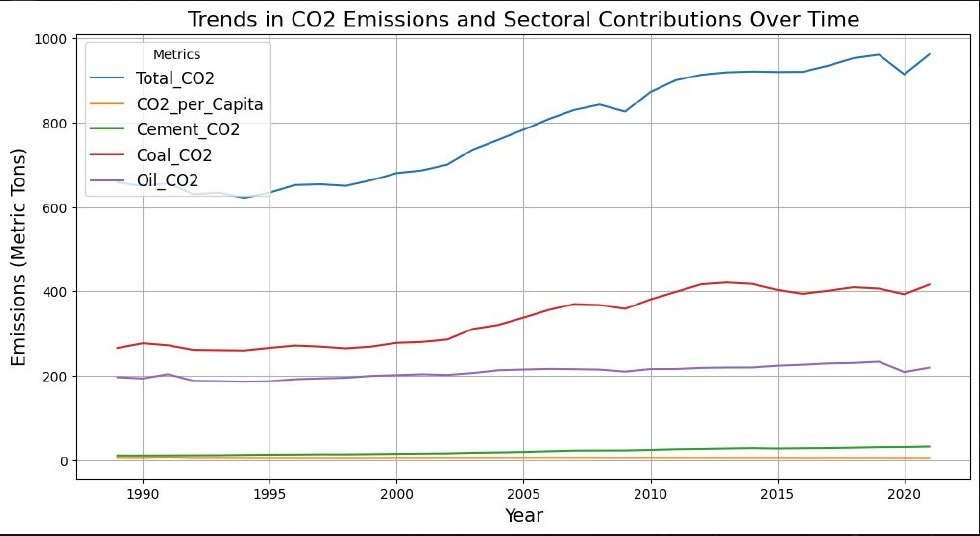
Cap-and-trade and carbon emissions
Environmental economicsDo carbon-pricing schemes cut emissions without holding back growth? Three global datasets merged in Python and tested with OLS.
Read case studyEconomics student at Nagoya University, combining financial modeling, SQL and econometrics to find what drives performance.
Turning economic theory into evidence. Four pieces of work are open right now.
Do carbon-pricing schemes cut emissions without holding back growth? Three global datasets merged in Python and tested with OLS.
Read case studyA 2011 study found that unemployment pushes workers into the gig economy. This project tests whether that still holds in Indonesia today.
Read case studyA smartphone app that screens water from a single photo: dominant colours, classified by a neural network trained on 5,053 labelled values.
Read case studyBuilding DCF and cash-flow models with sensitivity and scenario analysis to show how valuations shift under different risk assumptions.
Querying and cleaning complex datasets in SQL to surface market trends and operational bottlenecks, then turning them into clear recommendations.
Using regression and time-series methods in Stata and Python to test economic theories against real-world data. Try the Okun's law Model Lab See the cap-and-trade OLS
Training neural networks in Python with TensorFlow and Keras. A colour classifier trained on 5,053 labelled RGB values reached 88% test accuracy. See the water-quality model
Okun's law says faster growth cuts unemployment. Estimate it on real data and see where it breaks.
Change in the unemployment rate regressed on real GDP growth by OLS, annual data 1992–2024, six economies. Source: World Bank World Development Indicators (unemployment is the modelled ILO estimate), retrieved 30 October 2026.
β = −0.041
In Indonesia, growth and unemployment barely move together: the slope is not distinguishable from zero (p = 0.148).
The slope is too imprecise to say what growth keeps unemployment steady.
| Coef. | Std. err. | t | p | 95% CI | |
|---|---|---|---|---|---|
| Intercept | 0.208 | 0.161 | 1.29 | 0.206 | [−0.121, 0.537] |
| GDP growth | −0.041 | 0.028 | −1.48 | 0.148 | [−0.097, 0.015] |
n = 33 · R² = 0.066 · classical standard errors · 1992–2024
Self-employed: share of all employment in 2024, modelled ILO estimate. Rows with a hollow dot are not significant at 5%.
In 1998 Indonesia's economy shrank 13.1%, yet measured unemployment rose by less than one point. About half of all workers are self-employed, so lost jobs show up as informal and gig work rather than open unemployment. That is the link my minimum-wage project re-tests.
A two-variable OLS on annual data describes how growth and unemployment move together; it is not a causal estimate. The ILO figures are modelled, and 2025 values, which are projections, are left out.
I’m an economics student in the G30 program at Nagoya University, interested in how macroeconomic forces show up in real labor markets and in the environment. My current project looks at minimum wage in Indonesia and the macroeconomic factors that drive it, and tests whether a 2011 study’s finding that unemployment pushes workers into the gig economy still holds today.
I enjoy turning messy data into something I can reason with. In my first year, I studied corporate social responsibility initiatives alongside the economics of environmental policy, cleaning a real dataset and forecasting outcomes under a cap-and-trade system. I work with Stata, Python and SQL, and I’m looking for internships and research roles where I can keep connecting economic theory to evidence.